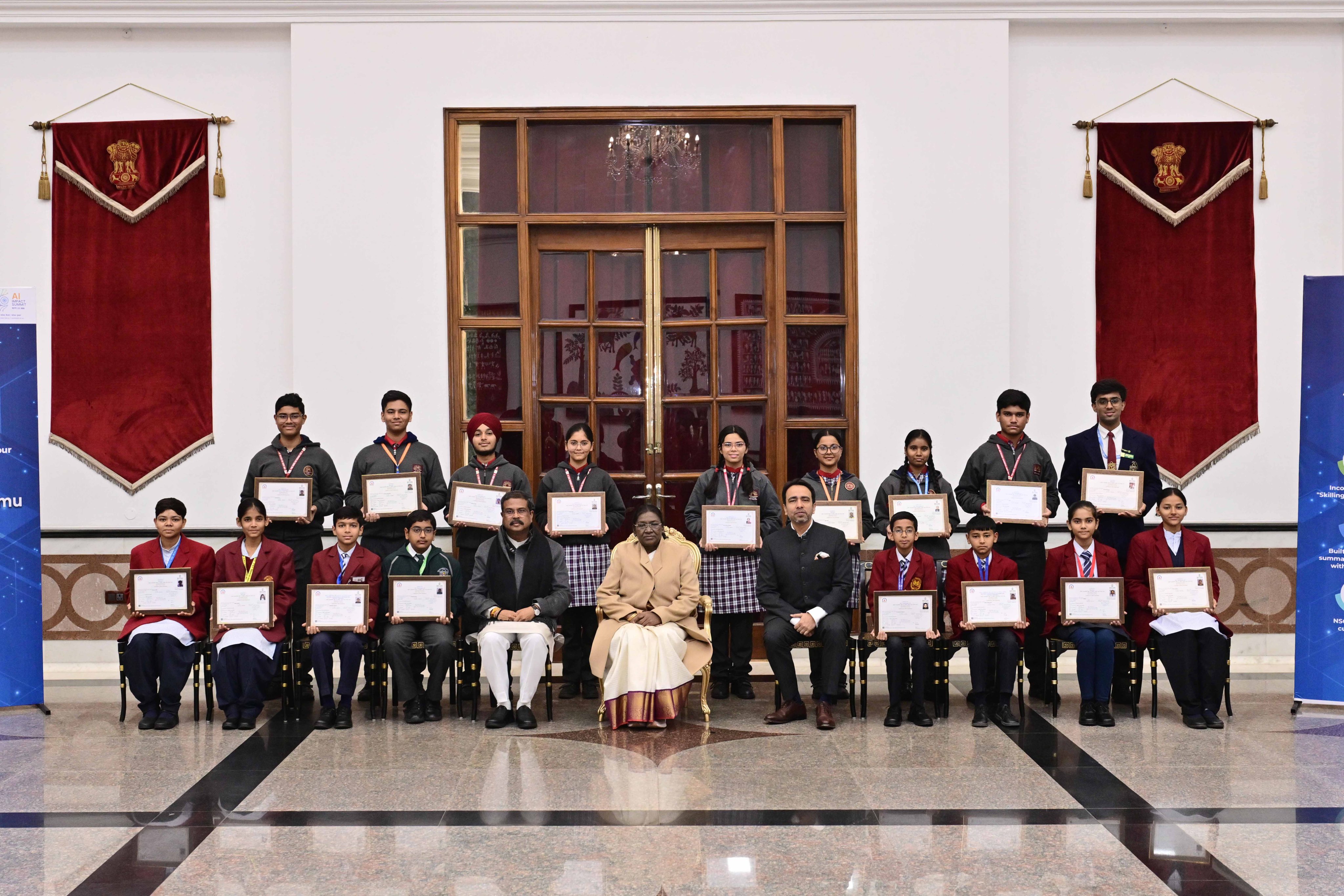
Before he had finished high school, Akshat Bhaskar stood beneath the domes of Rashtrapati Bhavan to be felicitated by the President of India, Shri Droupadi Murmu, for his work on Artificial Intelligence. He was one of seventeen students chosen from across the country under the Government of India's SOAR initiative, and among the youngest people in the hall. The felicitation reads less as a beginning than as a punctuation mark set into the middle of a sentence, placed over a body of work already several years deep.
That work returns, again and again, to a single question. Akshat has carried it into classrooms, ministries, card games, and research seminars alike: how can young people, and above all those in underresourced contexts, gain access to the knowledge and agency that shape their futures? What follows is an account of the ways he has tried to answer it.
"None of it was bought, coached, or counselled into existence."
His answer began with money, and with the fact that so few young people are ever taught how it works. While still in school, Akshat founded the India Chapter of the Edunomix Institute, a United States 501(c)(3) nonprofit devoted to financial literacy, establishing the organisation's first presence in South Asia. Under his direction the chapter ran nationwide essay competitions reaching across nineteen states and fifty-four schools, held spring and summer camps in personal finance, and taught economic literacy to displaced Ukrainian students as they rebuilt their lives far from home.
The same conviction carried into TaxCity, a government-recognised card game that teaches tax filing and the machinery of public finance. As its Chief Financial Officer, Akshat took charge of grants, revenue, and impact. During his tenure TaxCity raised more than $120,000 in grants, generated over ₹550,000 in revenue, and earned formal recognition from the Ministry of Education, Government of India. Its programmes have now reached more than 79,000 young Indians, many of whom had never been shown how taxation or public spending touches their daily lives. For a generation taught to fear the tax form, he turned fiscal literacy into something closer to play.
Where TaxCity approached the system from below, Akshat's policy work approached it from within. His research on the socio-economic dimensions of Artificial Intelligence, conducted under Professor Surbhi Goel of the University of Pennsylvania, matured into a peer-reviewed paper published internationally in IJRASET (Volume 13, Issue 7, 2025). He presented the work at the NYC STEM Research Conference, where he was the only high-school student in the room, and held his own among graduate researchers and faculty.
At the same time he served as a Quantitative Policy Intern at the Ministry of Education, Government of India, contributing to internal analysis of the Samagra Shiksha Scheme under Mr. Rahul Pachori, Director. The posting placed him inside the room where India's education system is measured and revised, studying the financial architecture and budget flows of the country's flagship schooling programme under the National Education Policy 2020. Few students his age have read the national education budget line by line; fewer still have been asked to.
Beneath the policy and the fieldwork runs a quieter, more austere discipline. Akshat was admitted to the Lodha Genius Programme at Ashoka University, a fully funded residential programme with an acceptance rate near three percent, built for the most mathematically gifted school students in the country. There he completed university-level coursework in pure mathematics, number theory, group theory, linear algebra, and geometry, and attended the programme's Great Ideas Seminars alongside Nobel laureates, among them Sir Paul Nurse and Professor Brian Schmidt.
He has since continued into original research. As part of a mathematics apprenticeship under Professor Shanta Laishram, Head of the Statistics and Mathematics Unit at the Indian Statistical Institute in Delhi, he works in analytic and algebraic number theory. It is the least visible of his pursuits, and by his own account the one he would keep if he could keep only one.
The published AI paper is the most cited of his writings, though far from the only one. His essay "How Economics Runs the World" appeared in Arbitrage, the finance and investment journal of IIM Rohtak, where he was the only high-school author in the issue. He has conducted research on tail risk and black-swan events at the Indian School of Business and Finance under Professor Kritika Soni, studied the effect of the National Education Policy 2020 on graduate employability, and was selected into the Junior Academy of the New York Academy of Sciences. Across finance, governance, and mathematics, the writing traces one preoccupation: how systems encode knowledge, and who is permitted to read them.
Ideas, in Akshat's view, are only as useful as their reach. He hosts Decoded, a podcast that interviews economists and technologists and translates their thinking for anyone willing to listen, with no jargon and no prerequisites. His writing and commentary have drawn an audience of more than seven thousand on LinkedIn, and his selection to the Lodha Genius Programme was profiled by both the Lodha Group and the Lodha Foundation before a combined audience of over half a million.
He has spent time close to the people who build at scale as well. At Y Combinator's inaugural Startup School India he was among two thousand founders and engineers chosen nationwide, pitched his financial-literacy work directly to YC partner Jared Friedman, received an AI compute grant of more than $25,000, and met the founding teams of Zepto, Razorpay, Groww, and Meesho. Earlier he had been selected, from a global pool of thirty-two thousand applicants, into the s3 cohort of buildspace, a programme built around shipping real products to real users.
The felicitation at Rashtrapati Bhavan is the most public of Akshat's distinctions, and it sits among many. He ranked forty-fourth of more than sixty-seven thousand students in Delhi's state science examination, inside the top 0.06 percent. He has been admitted, on full or near-full scholarships, to Yale Young Global Scholars, LaunchX at MIT, and The Knowledge Society; placed in the top one percent of an Oxford essay competition; earned a place on the national merit list of the Indian Olympiad Qualifier in Mathematics; and completed the National Space Innovation Challenge run by the Atal Innovation Mission with ISRO. The full record runs to more than thirty honours.
His commitments reach past the study and the ministry. For five years he has volunteered with Familial Forestry, the reforestation movement recognised by the United Nations Land for Life Award, and is working to open a chapter at his school. He captained his school to consecutive district football championships and served as President of the Student Council at Delhi Public School, R.K. Puram. The through-line is service rendered in public, at scale, and on the record.
What sets this trajectory apart is the near-total absence of external scaffolding. There was no educational counsellor, no paid coaching programme, no international curriculum, no IB and no A-levels. Akshat sat the ordinary CBSE examinations at Delhi Public School, R.K. Puram, and assembled everything else around them through curiosity and a willingness to begin things before he had been given permission to. He starts what does not yet exist, a nonprofit chapter, a research collaboration, a podcast, a competition, and then discovers who will join once it does.
None of it was bought, coached, or counselled into existence. It was, in the plainest sense, built.